Dr. Toni Farley
Engineer · Educator · Researcher

Full-stack generalist by design.

20+ years across frontend, backend, cloud architecture, security, and ML/AI — with a parallel career teaching computer science from high school through the doctoral level.

Full-stack generalist engineer and educator with 20+ years across the tech landscape — frontend, backend, cloud architecture, security, ML/AI, and data — and a parallel career teaching computer science and AI to students from high school through the doctoral level. PhD in Computer Science from Arizona State University.

Built and shipped end-to-end at every layer: serverless big-data architectures on AWS and GCP, Python/JavaScript full-stack applications, ML platforms (PyTorch, TensorFlow, scikit-learn), NLP pipelines, and production APIs serving 99%+ uptime with 70% latency improvements. Equally comfortable architecting service-oriented systems, optimizing cloud cost (90% savings on one DoD project), or writing the frontend that demos it.

Founder of tonia.ai, open lecture notes spanning the AI and computer science stack — from foundational programming and theory to applied machine learning and emerging fields like quantum. Former Staff Engineer at TargetSmart and Principal Investigator on Army SBIR and NSF-funded research. Deep security background from early BGP research at AT&T Labs and ASU's Information and Systems Assurance Lab — author of one of the most-cited BGP security surveys in the field.

Adjunct Professor teaching across the full CS curriculum: cloud development, deep learning, NLP, data science, secure coding, networking, databases, and programming in Python, Java, C++, C#, and JavaScript. 20+ peer-reviewed publications spanning network reliability, intrusion detection, QoS, and biomedical informatics.

Generalist by design — the engineer you want when the problem crosses boundaries.

Selected AI Projects

Generative AI for Leaders

Generative AI for Leaders

A practical guide to implementing and managing AI solutions in your organization.

View on Udemy
tonia.ai

Tonia AI

Open lecture notes spanning the AI and computer science stack — from foundational programming and theory to applied machine learning and quantum.

Visit tonia.ai
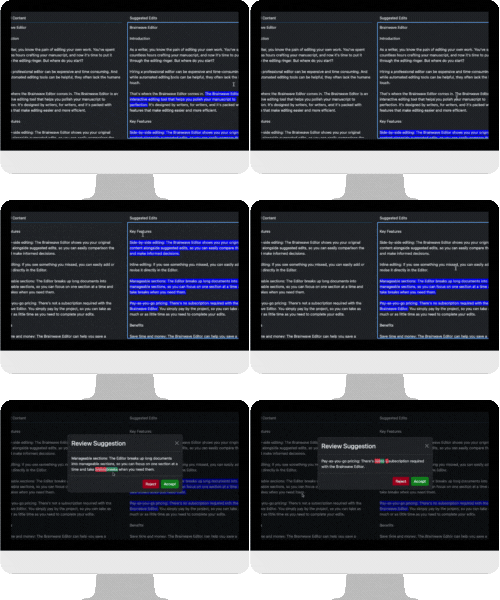
Brainwave Editor

Brainwave Editor

A pre-generative-AI writing editor designed to enhance your work without altering your words — built before LLMs reshaped the category.

Visit brainwave.one
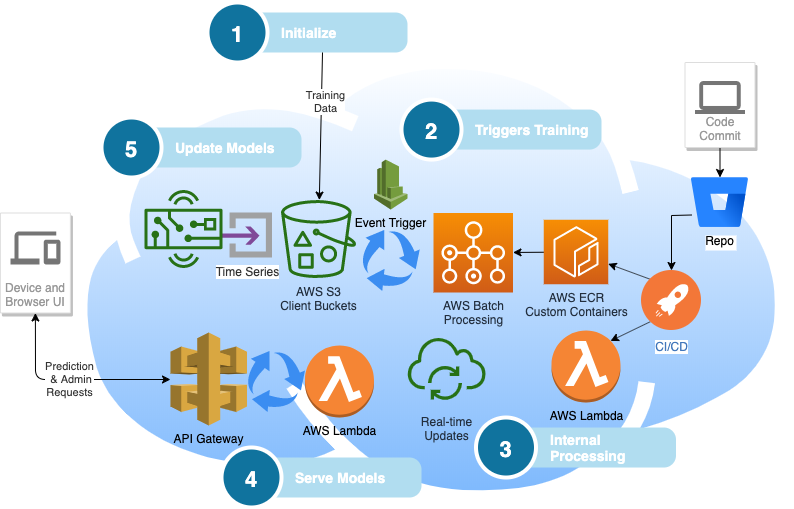
AWS ML Infrastructure
AWS ML training and serving infrastructure
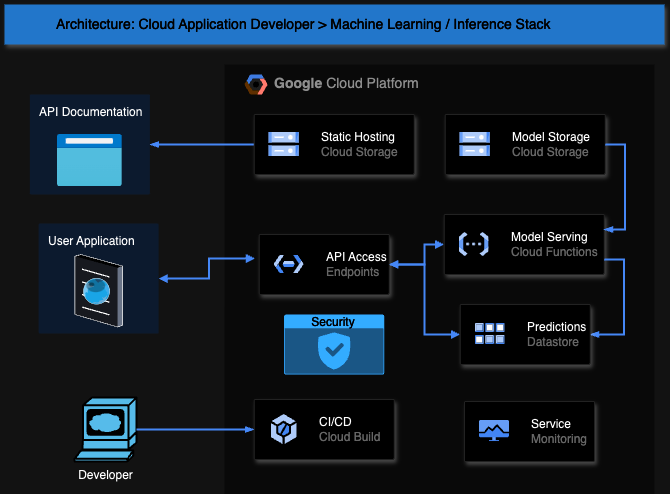
GCP ML Infrastructure
GCP ML training and serving infrastructure

Ventures & Pursuits

XYZ Galaxy Experiences

XYZ Galaxy Experiences

Robotic caricature entertainment for weddings, corporate activations, galas, and private celebrations.

Visit xyzgalaxy.com
Mars None

Mars None

A darkly comedic tale of the first Mars landing — gone wrong.

Visit marsnone.com
Prevent

Prevent

A science fiction series pilot exploring an unconventional storytelling format built for streaming. Currently in development.

Inquire

Publications

Network Security & BGP
  • Highly-cited BGP security survey with AT&T Labs
  • Cyberattack detection and classification
Systems Reliability & Performance
  • Network reliability and resilience
  • QoS optimization for web servers and routers
  • Job scheduling and performance research
Biomedical Informatics
  • BioIntelligence Framework (JAMIA)
  • Genomic analysis on pediatric leukemia
Most Cited Works
  • Survey of BGP Security Issues and Solutions (Proc. IEEE)
  • The BioIntelligence Framework (JAMIA)
  • Multiterminal Network Resilience (Networks)
  1. Wai D, Arceci R, et al. "Abstract 5583: Integrative genomic analyses on pediatric acute myeloid leukemia," Cancer Research 74(19 Supplement):5583, September 2014.
  2. Farley T, Kiefer J, Von Hoff D, Trent JM, Colbourn C, Mousses S. "The BioIntelligence Framework: a new computational platform for biomedical knowledge computing," JAMIA, August 2012, doi: 10.1136/amiajnl-2011-000646.
  3. Butler K, Farley T, McDaniel P, Rexford J. "A Survey of BGP Security Issues and Solutions," Proceedings of the IEEE, 98:1, 2010, pp. 100–122.
  4. Farley T, Colbourn C. "Multiterminal Measures for Network Reliability and Resilience," Design of Reliability Communication Networks, Oct 2009, pp. 107–114.
  5. Farley T, Colbourn C. "Multi-Terminal Network Connectedness on Series-Parallel Networks," Discrete Mathematics, Algorithms and Applications, 1:2, 2009, pp. 253–265.
  6. Ye N, Li X, Farley T, Xu X. "Job Scheduling Methods for Reducing Waiting Time Variance," Computers and Operations Research, 34:10, October 2007, pp. 3069–3083.
  7. Farley T, Colbourn C. "Multiterminal Resilience for Series-Parallel Networks," Networks, 50:2, September 2007, pp. 164–172.
  8. Ye N, Lai Y-C, Farley T. "Quality of Service Assurance for Dependable Information Infrastructure," Information Security Research, Wiley, Ch. 1.2.1, pp. 53–79, 2007.
  9. Ye N, Farley T, Li X, Bashettihalli H. "Batch Scheduled Admission Control for Computer and Network Systems," Information, Knowledge, Systems Management, 5:4, 2006, pp. 211–226.
  10. Ye N, Farley T, Lakshminarasimhan D. "An Attack-Norm Separation Approach for Detecting Cyber Attacks," Information Systems Frontiers, 8:3, July 2006, pp. 163–177.
  11. Ye N, Farley T. "Information Sharing and Control in Homogeneous and Heterogeneous Supply Networks," Int'l Journal of Modelling and Simulation, 26:2, 2006.
  12. Farley T, Joseph J. "Intrusion Detection," Encyclopedia of Cryptography and Security, Springer, 2005.
  13. Ye N, Newman C, Farley T. "A System-Fault-Risk Framework for Cyber Attack Classification and Profiling," Information, Knowledge, Systems Management, 5:2, 2005–2006, pp. 135–151.
  14. Ye N, Farley T. "A Scientific Approach to Cyberattack Detection," IEEE Computer, 38:11, November 2005, pp. 55–61.
  15. Ye N, Yang Z, Lai Y-C, Farley T. "Enhancing router QoS through job scheduling with weighted shortest processing time-adjusted," Computers and Operations Research, 32:9, Sept 2005, pp. 2255–2269.
  16. Ye N, Gel ES, Li X, Farley T, Lai Y-C. "Web server QoS models: applying scheduling rules from production planning," Computers and Operations Research, 32:5, May 2005, pp. 1147–1164.
  17. Ye N, Harish B, Farley T. "Attack Profiles to Derive Data Observations, Features, and Characteristics of Cyber Attacks," Information, Knowledge, Systems Management, 5:1, Jan 2005, pp. 23–47.
  18. Butler K, Farley T, McDaniel P. "A Survey of BGP Security Issues and Solutions," Technical Report TD-5UGJ33, AT&T Labs — Research, Florham Park, NJ, February 2004.
  19. Ye N, Farley T, Aswath D. "Data Measures and Collection Points to Detect Traffic Condition Changes on Large-Scale Computer Networks," IKSM, 4:4, Dec 2004, pp. 215–224.
  20. Chen Y, Farley T, Ye N. "QoS Requirements of Network Applications on the Internet," IKSM, 4:1, Jan 2004, pp. 55–76.
  21. Ye N, Lai Y-C, Farley T. "Dependable Information Infrastructures as Complex Adaptive Systems," Systems Engineering, 6:4, 2003, pp. 225–237.
  22. Ye N, Li X, Farley T. "A data mining technique for discovering distinct patterns of hand signs," Ergonomics, 46(1–3), 2003, pp. 188–196.
  23. Ye N, Chen Y, Farley T. "QoS Requirements of Multimedia Data on Computer Networks," Proc. 2nd Int'l Conf on Active Media Technology, 2003, pp. 183–189.

Course Development & Teaching

Graduate Courses
  • Enterprise AI for Business Strategies
  • Neural Networks and Deep Learning
  • Natural Language Processing
  • Predictive Analytics
  • Data Science with Python
  • Advanced Theoretical Computer Science
  • Quantum Cryptography
Undergraduate Courses
  • Cloud Application Development with GCP
  • Introduction to Theoretical Computer Science
  • Principles of Programming Languages
  • Programming with Python, Java, C++, C#
  • Software Testing & Quality Assurance
  • Secure Coding with C/C++
  • Database Systems & Programming Fundamentals
  • Application Development: Frontend
  • Application Development: Backend
  • Business Application Programming with Java
  • Web Development with ASP.NET
  • Introduction to Data Science
  • Information and Data Management
  • Mathematical Foundations of Data Science
  • Computer Literacy
  • Technology and Society
  • Computer Networks